Swana Logo     Home  |  Stallions  |  Mares  |  Ads  |  Inspection Tour  |  Newsletter  |  My Account  |   | 

The Quality Test
The Quality Test is an assessment of dressage and jumping talents, consisting of the 4-year-old division and the open division for horses from 5 to 10 years of age. Horses that have been inspected before are welcome to return into the Quality Test.

For the 4-year-old division, mares that were bred at age four may enroll in the Quality Test as five-year-olds. Horses in this division are eligible for diplomas.

The New Open division of the Quality Test is for horses from 5 to 10 years of age. Horses in this division receive an excellence award if they score in the top of the class. Mares who are attempting to enter the studbook may show their riding performance in this division.

Horses are tested and evaluated at three stations. These three areas are health, exterior and gaits, and the choice of free jumping or jumping under saddle. If the assessment is interrupted by the judge, the horse will receive a rating based on the stations completed.

Overview

  • Identity verification
  • Registration verification
  • Health check
  • Riding test
  • Conformation evaluation
  • Jumping test (Owner chooses between free or under saddle.)
Health Check
  • Horse must be presented in a bridle with reins.
  • No shoes with pads.
  • No studs.
  • Handler must wear appropriate attire for showing horse in hand.
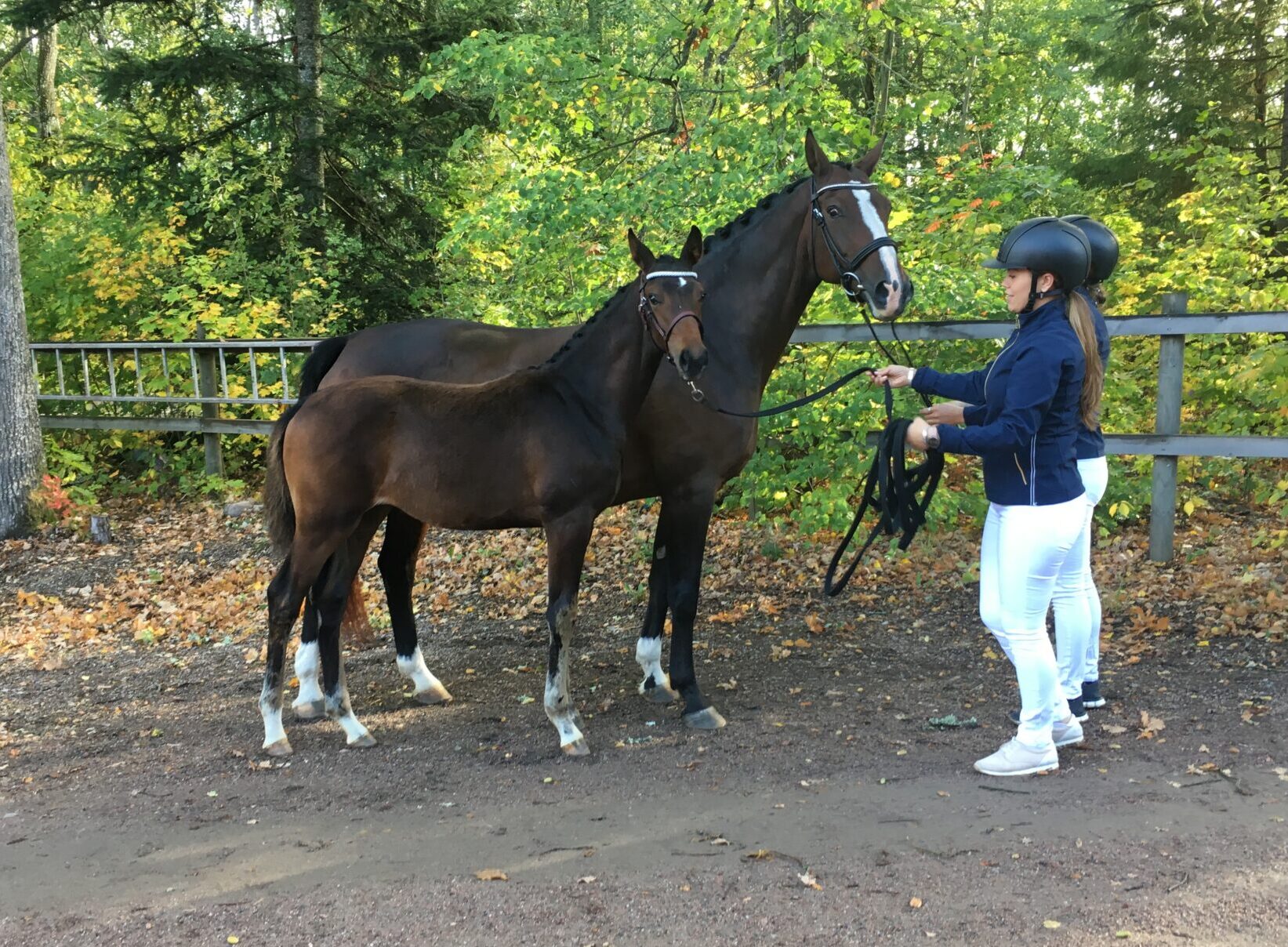
Judges will examine the horse’s eyes, ears, mouth, hooves, and palpation of the legs. The handler will be asked to present the horse at a walk and trot on a straight line, shown in hand. The horse should be prepared to have a stranger touch its eyes, ears, and legs and must be comfortable lifting up its feet. The horse will be measured on hard level surface.

Conformation & Gaits
Test is ridden in a 20 x 60 meter arena. Horse and rider are given a few minutes to get acquainted with the arena. The judge will give directions and the following work will be expected:

  • Working trot (posting), following the track in both directions.
  • 20 meter circles in both directions, showing transitions to the walk.
  • Show variations of lengthening the stride and tempo of the trot, down the long side or across the diagonal.
  • Walk in both directions on a long rein and with light contact, then back to a working trot, making the transitions to canter.
  • Working canter on 20 meter circles, showing the canter in a two point position (light seat).
  • On the 20 meter circles, the reins must be given for 2-3 strides to show proof of self-carriage.
  • On the middle circle, during posting trot, stretch the horse (long and low) while maintaining the trot rhythm.
  • Free walk.
  • Dismount and remove saddle. Line up on the centerline for conformation judging.

Jumping Under Saddle
Owner chooses between free or under saddle.

WARM-UP:

  • The horse will trot around the arena prior to the beginning of the jumping test.
  • The horse will warm-up over a set of jumps
    • Jump number 2 on the diagonal line must be jumped twice - 70 cm.
    • Jump once over the combination 1A + 1B with 2 canter stride.
    • Jump obstacle 1A - 70cm & obstacle 1B - 90cm without the back pole on the oxer.
Set 1
Combination Obstacle 1A
Obstacle 1B
(oxer)
70cm
90cm + 1m at the back pole
Length 90cm
Vertical Obstacle 2 90cm
Set 2a — Jumping this set of obstacles is worth a score of 5.
Combination Obstacle 1A
Obstacle 1B
(oxer)
70cm
90cm + 1m at the back pole
Length 1.1m
Set 2b
Combination Obstacle 1A
Obstacle 1B
(oxer)
70cm
90cm + 1m at the back pole
Length 1.1m
Vertical Obstacle 2 90cm
Oxer Obstacle 3 80cm + 90cm at the back pole. Length 1m
Vertical Obstacle 4 1m
Set 3
Combination Obstacle 1A
Obstacle 1B
(oxer)
70cm
90cm + 1.1m at the back pole
Length 1.1m
Vertical Obstacle 2 1m
Oxer Obstacle 3 90cm + 1m at the back pole. Length 1m
Vertical Obstacle 4 1.1m
The judge may ask to see the horse jump over a few more jumps to see the horse take off spot in both canter leads. The judges will score the horse’s technical ability and temperament/rideability and overall impression.

Free Jumping
Owner chooses between free or under saddle.

A help fence will be used, consisting of a pole approximately 70cm (28”) high and a ground-rail at the same distance in front of the fence.

The help fence is placed 7.0 meters in front of the main fence. The distance may be adjusted due to the length of the stride of the horse.

The score will be negatively affected if the distance must be shortened to less than 6.8 meters or lengthened to exceed 7.5 meters.

The distances 6.8, 7.0, and 7.5 meters, shall be marked on the wall.

The oxer must have no fill and have the rear rail 10 centimeter higher than the front one. A ground rail must be placed 30 centimeters in front of the obstacle. The rear rail must rest on safety supports. Empty steel rail supports must never be left on the standards.

The heights 1.1, 1.2, and 1.3 meters must be visibly marked on the inner standard and the length of 1.2 meters must be marked on the wall.

The horse will be allowed to jump 2 to 3 times without the rear rail on the oxer.

Thereafter the help fence and the full oxer are jumped. The initial height shall be 80 centimeter (31.5”) and is gradually increased so that after approximately 6 attempts, a height of 1.1 meters and the maximal length of 1.2 meters is reached. This obstacle size is required for the horse to achieve 5 points for the free jumping. Further increase to maximally 1.3 meters may be done for horses that show capacity. The length of the obstacle shall remain at 1.2 meters and the type of the fence a normal oxer.

Equipment
The horse must wear a bridle with a cavason and reins at all times. A regular snaffle bit, single or double jointed, is recommended. Soft rubber bits or shanks are not permitted.

An English saddle must be used.

Boots for the jumping part are allowed for the front legs only, no hind boots or wraps.

The rider must wear formal attire with an approved helmet; whips and spurs are optional. Stallion riders must carry a whip.

Arena
The arena is 20 by 60 meters. (65’ 7” by 196’ 10”)

Order
1. Health Check Station (V)
2. Exterior (E) & Gaits (G)
3. Jumping Under Saddle (H) or Free Jumping (LH)

Judges
Two ASVH-approved judges authorized to judge the elements of the test, will evaluate conformation, jumping and rideability. When a special judge is used for the riding test, he/she must be a gaits judge and approved beforehand by ASVH.

Doping
Horses participating in the Quality Test must not be doped (drugged) with prohibited substances or other disallowed means that can affect performance or temperament.

Pregnancy
Pregnant mares that are 5 or more months into the pregnancy may not participate in the quality test.

Scoring
Individual elements scoring
Health Check (V) 1 – 10 (Scores above 8 count as 8)
Conformation (E) (Type+ HNB+ Legs)/3
Gaits (G) Median score for Walk, Trot, and Canter
Temperament/Rideability/Gaits (TG) 1 – 10
Jumping Under Saddle Technique & Ability (H) 1 – 10
Jumping under saddle jumping temperament and general impression (TH) 1 – 10
Free jumping technique and ability (LH) 1 – 10
Free jumping temperament and general impression (TLH) 1 – 10
Combined scoring
Two different scores are then calculated …
Score as a promising dressage horse (V+E+2G=TG)/5
Score as a promising jumping horse (V+E+2LH+TLH)/5 or (V+E+2H+TH)/5

Awards
Ribbons are awarded to all horses that successfully complete the test.

Class I is awarded to horses with a minimum of 7.4 as a promising dressage horse or 7.5 as a promising jumping horse.

Diplomas are awarded to horses with a minimum of 7.8 as a promising dressage horse or 8.0 as a promising jumping horse and with no point lower than 7 on conformation.


Last updated on: 7/12/2010